
O-nitroaniline is an orange solid with a musty odor. Sinks and mixes slowly with water. (USCG, 1999)
 Akut toksik
 Sağlık tehlikesi
⚠️ Bilgi amaçlıdır; resmî Güvenlik Bilgi Formu (SDS) yerine geçmez.
O-nitroaniline is an orange solid with a musty odor. Sinks and mixes slowly with water. (USCG, 1999)
| Fiziksel görünüm | O-nitroaniline is an orange solid with a musty odor. Sinks and mixes slowly with water. (USCG, 1999) |
| Renk / Form | Yellow-orange crystals from boiling water |
| Koku | Musty |
| Erime noktası | 160.7 °F (NTP, 1992) |
| Kaynama noktası | 543 °F at 760 mmHg (NTP, 1992) |
| Parlama noktası | 335 °F (NTP, 1992) |
| Yoğunluk | 1.44 at 68 °F (USCG, 1999) - Denser than water; will sink |
| Çözünürlük | less than 1 mg/mL at 70.7 °F (NTP, 1992) |
| Buhar basıncı | 1 mmHg at 219.2 °F ; <0.1 mmHg at 86 °F (NTP, 1992) |
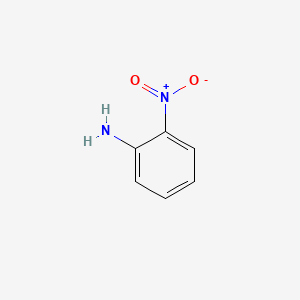
| IUPAC Adı | 2-nitroaniline |
| Molekül Formülü | C6H6N2O2 |
| Molekül Ağırlığı | 138.12 g/mol |
| CAS | 88-74-4 |
| SMILES | C1=CC=C(C(=C1)N)[N+](=O)[O-] |
| InChIKey | DPJCXCZTLWNFOH-UHFFFAOYSA-N |
| Katalog No | KC.1510014 |
| Ambalaj seçenekleri | 250GM |
⚠️ Bilgi amaçlıdır; resmî SDS yerine geçmez.