
2-Chloronitrobenzene can cause cancer according to California Labor Code.
 Acute toxic
 Health hazard
 Environmental hazard
⚠️ For information only; not a substitute for the official Safety Data Sheet (SDS).
2-Chloronitrobenzene can cause cancer according to California Labor Code.
| Physical Description | Either a clear yellow liquid or solid. Burns, but difficult to ignite. Denser than water and insoluble in water. Toxic by inhalation and skin absorption. Produces toxic oxides of nitrogen during co… |
| Color/Form | Yellow crystals |
| Melting Point | 90 to 91 °F (NTP, 1992) |
| Boiling Point | 475 °F at 760 mmHg (NTP, 1992) |
| Flash Point | 261 °F (NTP, 1992) |
| Density | 1.368 at 71.6 °F (USCG, 1999) - Denser than water; will sink |
| Solubility | less than 0.1 mg/mL at 67.8 °F (NTP, 1992) |
| Vapor Pressure | 0.4 mmHg at 77 °F (NTP, 1992) |
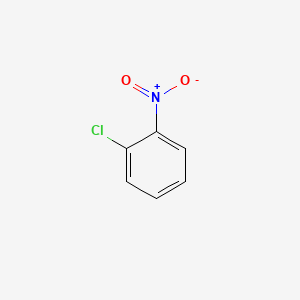
| IUPAC Name | 1-chloro-2-nitrobenzene |
| Molecular Formula | C6H4ClNO2 |
| Molecular Weight | 157.55 g/mol |
| CAS | 88-73-3 |
| SMILES | C1=CC=C(C(=C1)[N+](=O)[O-])Cl |
| InChIKey | BFCFYVKQTRLZHA-UHFFFAOYSA-N |
| Catalog No | KC.-1510016 |
| Pack sizes | 500GM |
⚠️ For information only; not a substitute for the official SDS.