
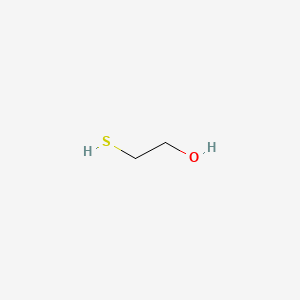
Mercaptoethanol is a primary alcohol and an alkanethiol. It has a role as a geroprotector.
 Corrosive
 Acute toxic
 Irritant
 Health hazard
 Environmental hazard
⚠️ For information only; not a substitute for the official Safety Data Sheet (SDS).
Mercaptoethanol is a primary alcohol and an alkanethiol. It has a role as a geroprotector.
| Physical Description | Thioglycol appears as a water-white liquid. May be toxic by ingestion, inhalation, or skin absorption. |
| Color/Form | Water-white mobile liquid |
| Odor | Strong disagreeable odor |
| Melting Point | -148 °F (NTP, 1992) |
| Boiling Point | 315 to 316 °F at 742 mmHg (decomposes) (NTP, 1992) |
| Flash Point | 165 °F (NFPA, 2010) |
| Density | 1.1143 at 68 °F (NTP, 1992) - Denser than water; will sink |
| Solubility | greater than or equal to 100 mg/mL at 68 °F (NTP, 1992) |
| Vapor Pressure | 1 mmHg at 68 °F (NTP, 1992) |
| Refractive Index | Index of refraction: 1.4996 at 20 °C/D |
| IUPAC Name | 2-sulfanylethanol |
| Molecular Formula | C2H6OS |
| Molecular Weight | 78.14 g/mol |
| CAS | 60-24-2 |
| SMILES | C(CS)O |
| InChIKey | DGVVWUTYPXICAM-UHFFFAOYSA-N |
| Catalog No | KC.-1410047 |
| Pack sizes | 100ML · 500ML |
⚠️ For information only; not a substitute for the official SDS.