
oxyquinoline has been reported in Cortinarius subtortus and Allium stipitatum with data available.
 Corrosive
 Acute toxic
 Health hazard
 Environmental hazard
⚠️ For information only; not a substitute for the official Safety Data Sheet (SDS).
oxyquinoline has been reported in Cortinarius subtortus and Allium stipitatum with data available.
| Physical Description | 8-hydroxyquinoline appears as white to off-white or faintly yellow crystalline powder. Phenolic odor. (NTP, 1992) |
| Color/Form | White crystals or white crystalline powder |
| Odor | Phenolic odor |
| Melting Point | 169 °F (NTP, 1992) |
| Boiling Point | 513 °F at 760 mmHg (NTP, 1992) |
| Density | 1.034 at 408 °F (NTP, 1992) - Denser than water; will sink |
| Solubility | less than 1 mg/mL at 61 °F (NTP, 1992) |
| Vapor Pressure | 0.0016 [mmHg] |
| Stability/Shelf Life | DARKENS WHEN EXPOSED TO LIGHT. |
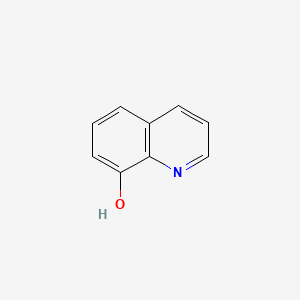
| IUPAC Name | quinolin-8-ol |
| Molecular Formula | C9H7NO |
| Molecular Weight | 145.16 g/mol |
| CAS | 148-24-3 |
| SMILES | C1=CC2=C(C(=C1)O)N=CC=C2 |
| InChIKey | MCJGNVYPOGVAJF-UHFFFAOYSA-N |
| Catalog No | KC.-810000 |
| Pack sizes | 100GM · 500GM |
⚠️ For information only; not a substitute for the official SDS.