
allyl alcohol has been reported in Allium sativum with data available.
 Flammable
 Acute toxic
 Environmental hazard
⚠️ For information only; not a substitute for the official Safety Data Sheet (SDS).
allyl alcohol has been reported in Allium sativum with data available.
| Physical Description | Allyl alcohol appears as a clear colorless liquid with a mustard-like odor. Flash point 70 °F. Very toxic by inhalation and ingestion. Less dense than water (7.1 lb / gal). Vapors are heavier than … |
| Color/Form | Colorless liquid |
| Odor | Pungent, mustard-like odor |
| Melting Point | -200 °F (EPA, 1998) |
| Boiling Point | 206 °F at 760 mmHg (EPA, 1998) |
| Flash Point | 71.6 °F (EPA, 1998) |
| Density | 0.854 at 68 °F (EPA, 1998) - Less dense than water; will float |
| Solubility | Miscible (NIOSH, 2024) |
| Vapor Pressure | 23.8 mmHg at 77 °F (EPA, 1998) |
| Refractive Index | Index of refraction: 1.41345 at 20 °C/D |
| Stability/Shelf Life | Upon storage for several years allyl alcohol polymerizes and a thick syrup is formed (insol in water, sol in chloroform) which on treatment with ether yields a brittle resinoid mass ... . |
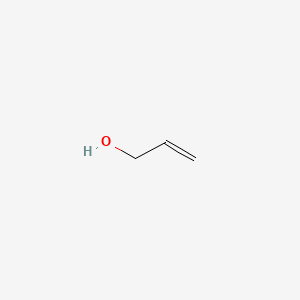
| IUPAC Name | prop-2-en-1-ol |
| Molecular Formula | C3H6O |
| Molecular Weight | 58.08 g/mol |
| CAS | 107-18-6 |
| SMILES | C=CCO |
| InChIKey | XXROGKLTLUQVRX-UHFFFAOYSA-N |
| Catalog No | KC.110110 |
| Pack sizes | 500ml · 2.5ltr |
⚠️ For information only; not a substitute for the official SDS.