
Benzotrichloride can cause cancer according to an independent committee of scientific and health experts.
 Corrosive
 Acute toxic
 Health hazard
⚠️ For information only; not a substitute for the official Safety Data Sheet (SDS).
Benzotrichloride can cause cancer according to an independent committee of scientific and health experts.
| Physical Description | Benzotrichloride appears as a clear colorless to yellowish colored liquid with a penetrating odor. Denser than water and vapors are heavier than air. May be toxic by inhalation or ingestion. Burns … |
| Color/Form | CLEAR, COLORLESS TO YELLOWISH LIQUID |
| Odor | PENETRATING |
| Melting Point | 23 °F (EPA, 1998) |
| Boiling Point | 429.4 °F at 760 mmHg (EPA, 1998) |
| Flash Point | 260 °F (EPA, 1998) |
| Density | 1.3756 at 68 °F (EPA, 1998) - Denser than water; will sink |
| Solubility | Decomposes (NTP, 1992) |
| Vapor Pressure | 1 to 10 mmHg at 114.44 to 189.68 °F (EPA, 1998) |
| Refractive Index | INDEX OF REFRACTION: 1.55789 AT 20 °C/D |
| Stability/Shelf Life | UNSTABLE; HYDROLYZES IN PRESENCE OF MOISTURE, FORMING BENZOIC AND HYDROCHLORIC ACIDS. |
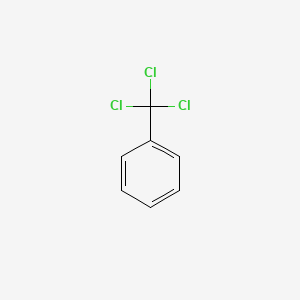
| IUPAC Name | trichloromethylbenzene |
| Molecular Formula | C7H5Cl3 |
| Molecular Weight | 195.5 g/mol |
| CAS | 98-07-7 |
| SMILES | C1=CC=C(C=C1)C(Cl)(Cl)Cl |
| InChIKey | XEMRAKSQROQPBR-UHFFFAOYSA-N |
| Catalog No | KC.210076 |
| Pack sizes | 500ML |
⚠️ For information only; not a substitute for the official SDS.