
RN given refers to B2O3
 Health hazard
⚠️ For information only; not a substitute for the official Safety Data Sheet (SDS).
RN given refers to B2O3
| Physical Description | Boron oxide appears as colorless, semi-transparent glassy lumps or hard white odorless crystals. Mp 450 °C; bp: 1860 °C. Density: 2.46 g cm-3. Moderately soluble in water. Used as an insecticide; a… |
| Color/Form | Colorless, brittle, vitreous, semitransparent lumps or hard, white crystals |
| Odor | Odorless |
| Melting Point | 842 °F (NIOSH, 2024) |
| Boiling Point | 3380 °F at 760 mmHg (NIOSH, 2024) |
| Density | 2.46 (NIOSH, 2024) - Denser than water; will sink |
| Solubility | 3 % (NIOSH, 2024) |
| Vapor Pressure | 0 mmHg (approx) (NIOSH, 2024) |
| Refractive Index | INDEX OF REFRACTION: 1.61 |
| Stability/Shelf Life | Keep dry |
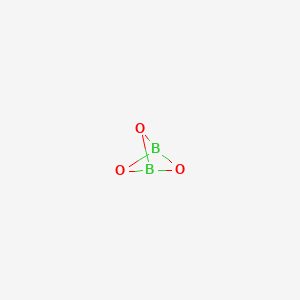
| IUPAC Name | 2,4,5-trioxa-1,3-diborabicyclo[1.1.1]pentane |
| Molecular Formula | B2O3 |
| Molecular Weight | 69.63 g/mol |
| CAS | 1303-86-2 |
| SMILES | B12OB(O1)O2 |
| InChIKey | RPPTVYMVSNHGRG-UHFFFAOYSA-N |
| Catalog No | KC.210160 |
| Pack sizes | 250GM · 1KG |
⚠️ For information only; not a substitute for the official SDS.