
Chromic acetate appears as a grayish green to bluish green powder. The primary hazard is the threat to the environment. Immediate steps should be taken to limit its spread to the environment. It is used in tanning and in textile dyeing.
 Irritant
⚠️ For information only; not a substitute for the official Safety Data Sheet (SDS).
Chromic acetate appears as a grayish green to bluish green powder. The primary hazard is the threat to the environment. Immediate steps should be taken to limit its spread to the environment. It is used in tanning and in textile dyeing.
| Physical Description | Chromic acetate appears as a grayish green to bluish green powder. The primary hazard is the threat to the environment. Immediate steps should be taken to limit its spread to the environment. It is… |
| Color/Form | Blue-green powder |
| Odor | Odorless |
| Melting Point | >400 °C (OECD Guideline 102 (Melting point / Melting Range) resp. EU A.1 (melting / freezing temperature)) |
| Boiling Point | 212 °F at 760 mmHg for aqueous solution (USCG, 1999) |
| Density | 1.3 (USCG, 1999) - Denser than water; will sink |
| Solubility | In water, 675 g/L at 20 °C, pH 5 (OECD Guideline 105 (Water Solubility)) |
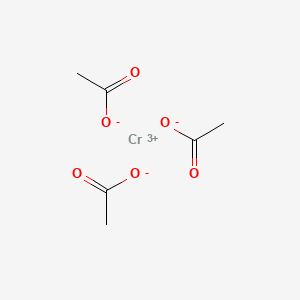
| IUPAC Name | chromium(3+) triacetate |
| Molecular Formula | C6H9CrO6 |
| Molecular Weight | 229.13 g/mol |
| CAS | 1066-30-4 |
| SMILES | CC(=O)[O-].CC(=O)[O-].CC(=O)[O-].[Cr+3] |
| InChIKey | WYYQVWLEPYFFLP-UHFFFAOYSA-K |
| Catalog No | KC.310191 |
| Pack sizes | 500GM |
⚠️ For information only; not a substitute for the official SDS.