
Cobalt Sulfate Heptahydrate can cause cancer according to The National Toxicology Program.
 Acute toxic
 Irritant
 Health hazard
 Environmental hazard
⚠️ For information only; not a substitute for the official Safety Data Sheet (SDS).
Cobalt Sulfate Heptahydrate can cause cancer according to The National Toxicology Program.
| Physical Description | Cobalt sulfate heptahydrate appears as pink to red monoclinic prismatic crystals or red granular solid. Odorless. Becomes anhydrous at 788 °F. (NTP, 1992) |
| Melting Point | 206.2 °F (NTP, 1992) |
| Boiling Point | 1355 °F at 760 mmHg (decomposes) (NTP, 1992) |
| Density | 2.03 at 77 °F (NTP, 1992) - Denser than water; will sink |
| Solubility | greater than or equal to 100 mg/mL at 64 °F (NTP, 1992) |
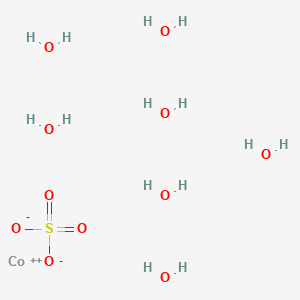
| IUPAC Name | cobalt(2+);sulfate;heptahydrate |
| Molecular Formula | CoH14O11S |
| Molecular Weight | 281.11 g/mol |
| CAS | 10026-24-1 |
| SMILES | O.O.O.O.O.O.O.[O-]S(=O)(=O)[O-].[Co+2] |
| InChIKey | MEYVLGVRTYSQHI-UHFFFAOYSA-L |
| Catalog No | KC.310238 |
| Pack sizes | 100GM · 500GM |
⚠️ For information only; not a substitute for the official SDS.