
diacetone alcohol has been reported in Camellia sinensis, Angelica gigas, and other organisms with data available.
 Irritant
⚠️ For information only; not a substitute for the official Safety Data Sheet (SDS).
diacetone alcohol has been reported in Camellia sinensis, Angelica gigas, and other organisms with data available.
| Physical Description | Diacetone alcohol appears as a clear colorless liquid with a pleasant odor. Flash point below 141 °F. Less dense than water. Vapors heavier than air. |
| Color/Form | COLORLESS LIQUID |
| Odor | FAINT PLEASANT ODOR |
| Melting Point | -45 °F (USCG, 1999) |
| Boiling Point | 328 °F at 760 mmHg (USCG, 1999) |
| Flash Point | 125 °F (USCG, 1999) |
| Density | 0.938 at 68 °F (USCG, 1999) - Less dense than water; will float |
| Solubility | Miscible (NIOSH, 2024) |
| Vapor Pressure | 3.62 mmHg (USCG, 1999) |
| Refractive Index | INDEX OF REFRACTION: 1.4232 AT 20 °C/D |
| Stability/Shelf Life | DECOMPOSED BY PROLONGED EXPOSURE TO ALKALIS & BY DISTILLATION AT ATMOSPHERIC PRESSURE |
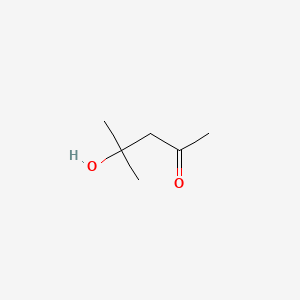
| IUPAC Name | 4-hydroxy-4-methylpentan-2-one |
| Molecular Formula | C6H12O2 |
| Molecular Weight | 116.16 g/mol |
| CAS | 123-42-2 |
| SMILES | CC(=O)CC(C)(C)O |
| InChIKey | SWXVUIWOUIDPGS-UHFFFAOYSA-N |
| Catalog No | KC.410033 |
| Pack sizes | 500ML · 2.5LTR |
⚠️ For information only; not a substitute for the official SDS.