
sales@klarchem.com +90 530 315 00 65 Mon–Sat: 09:00 – 18:00

LEAD PEROXIDE (Lead Dioxide)

Home/ Our Products/ LEAD PEROXIDE (Lead Dioxide)
LEAD PEROXIDE (Lead Dioxide)
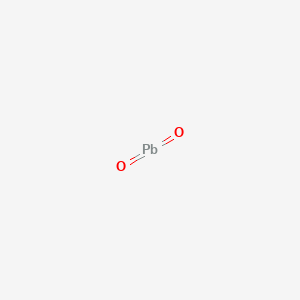
Molecular structure
Chemical Product

LEAD PEROXIDE (Lead Dioxide)

Cat. NoKC.1210083 CategoryOxides Molecular FormulaO2Pb CAS1309-60-0 Molecular Weight239 g/mol
Package 500GM
Safety & Hazards (GHS) Danger
Oxidizing Oxidizing Irritant Irritant Health hazard Health hazard Environmental hazard Environmental hazard

⚠️ For information only; not a substitute for the official Safety Data Sheet (SDS).

Lead dioxide appears as brown, hexagonal crystals. Insoluble in water. Used in matches, explosives, electrodes.
  • Used in matches, explosives, and electrodes; [CAMEO] Used to make dyes, matches, pyrotechnics, polysulfide polymers, and other chemicals; [Ullmann]
  • Oxidizing agent, electrodes, lead-acid storage batteries, curing agent for polysulfide elastomers, textiles (mordant, discharge in dyeing with indigo), matches, explosives, analytical reagent.
  • Manufacturing rubber substitutes; with amorphous phosphorus as ignition surface for matches; pyrotechny; manufacturing pigments.
  • Curing agent for polysulfide, low-molecular weight butyl and polyisoprene; used as an oxidizer in the manufacture of dyes and to control burning in incendiary fuses.
Physical DescriptionLead dioxide appears as brown, hexagonal crystals. Insoluble in water. Used in matches, explosives, electrodes.
Color/FormBrown, hexagonal crystals
Melting Point554 °F (decomposes) (NTP, 1992)
Density9.375 at 66 °F (NTP, 1992) - Denser than water; will sink
SolubilityInsoluble (NTP, 1992)
Refractive IndexIndex of refraction: omega 2.3 (Li /lamp/)
Stability/Shelf LifeStable under recommended storage conditions.
IUPAC Namedioxolead
Molecular FormulaO2Pb
Molecular Weight239 g/mol
CAS1309-60-0
SMILESO=[Pb]=O
InChIKeyYADSGOSSYOOKMP-UHFFFAOYSA-N
Catalog NoKC.1210083
Pack sizes500GM
  • H272 May intensify fire; oxidizer
  • H302 Harmful if swallowed
  • H332 Harmful if inhaled
  • H360 May damage fertility or the unborn child
  • H373 May causes damage to organs through prolonged or repeated exposure
  • H400 Very toxic to aquatic life
  • H410 Very toxic to aquatic life with long lasting effects

⚠️ For information only; not a substitute for the official SDS.

Request Offer & Detail