
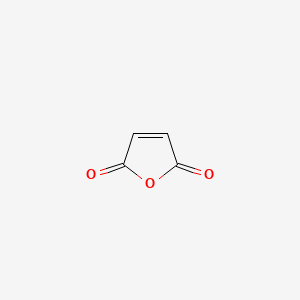
Maleic anhydride is a cyclic dicarboxylic anhydride that is the cyclic anhydride of maleic acid. It has a role as an allergen. It is a member of furans and a cyclic dicarboxylic anhydride.
 Corrosive
 Irritant
 Health hazard
⚠️ For information only; not a substitute for the official Safety Data Sheet (SDS).
Maleic anhydride is a cyclic dicarboxylic anhydride that is the cyclic anhydride of maleic acid. It has a role as an allergen. It is a member of furans and a cyclic dicarboxylic anhydride.
| Physical Description | Maleic anhydride appears as colorless crystalline needles, flakes, pellets, rods, briquettes, lumps or a fused mass. Melts at 113 °F. Shipped both as a solid and in the molten state. Vapors, fumes … |
| Color/Form | Orthorhombic needles from chloroform; commercial grades furnished in fused form, as briquettes |
| Odor | Pungent odor |
| Melting Point | 127 °F (NTP, 1992) |
| Boiling Point | 387 to 390 °F at 760 mmHg (NTP, 1992) |
| Flash Point | 218 °F (NTP, 1992) |
| Density | 1.43 at 59 °F (USCG, 1999) - Denser than water; will sink |
| Solubility | Soluble; decomposes in hot solvent (NTP, 1992) |
| Vapor Pressure | 0.2 mmHg (NIOSH, 2024) |
| Stability/Shelf Life | Stable under normal laboratory storage conditions. |
| IUPAC Name | furan-2,5-dione |
| Molecular Formula | C4H2O3 |
| Molecular Weight | 98.06 g/mol |
| CAS | 108-31-6 |
| SMILES | C1=CC(=O)OC1=O |
| InChIKey | FPYJFEHAWHCUMM-UHFFFAOYSA-N |
| Catalog No | KC.1310058 |
| Pack sizes | 100GM · 500GM |
⚠️ For information only; not a substitute for the official SDS.