
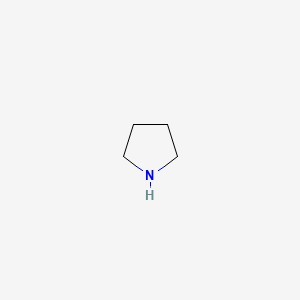
pyrrolidine has been reported in Cannabis sativa, Vitis vinifera, and other organisms with data available.
 Flammable
 Corrosive
 Irritant
⚠️ For information only; not a substitute for the official Safety Data Sheet (SDS).
pyrrolidine has been reported in Cannabis sativa, Vitis vinifera, and other organisms with data available.
| Physical Description | Pyrrolidine appears as a colorless to pale yellow liquid with an ammonia-like odor. Vapors heavier than air. Produces toxic oxides of nitrogen during combustion. |
| Color/Form | Colorless to pale yellow liq |
| Odor | Unpleasant, ammoniacal odor |
| Melting Point | -57.79 °C |
| Boiling Point | 86.56 °C |
| Flash Point | 37 °F (NFPA, 2010) |
| Density | 0.8520 at 22.5 °C/4 °C |
| Solubility | Soluble in ethanol, ethyl ether; slightly soluble in benzene, chloroform |
| Vapor Pressure | 62.7 [mmHg] |
| Refractive Index | Index of refraction: 1.4402 at 28 °C/D |
| Stability/Shelf Life | Fumes in air |
| IUPAC Name | pyrrolidine |
| Molecular Formula | C4H9N |
| Molecular Weight | 71.12 g/mol |
| CAS | 123-75-1 |
| SMILES | C1CCNC1 |
| InChIKey | RWRDLPDLKQPQOW-UHFFFAOYSA-N |
| Catalog No | KC.1610329 |
| Pack sizes | 250ML · 500ML |
⚠️ For information only; not a substitute for the official SDS.