
Trichloroacetyl chloride appears as a colorless volatile liquid with a strong odor. Denser than water. Contact severely irritates skin, eyes and mucous membranes. May be very toxic by ingestion and inhalation. May be combustible.
 Corrosive
 Acute toxic
 Irritant
 Environmental hazard
⚠️ For information only; not a substitute for the official Safety Data Sheet (SDS).
Trichloroacetyl chloride appears as a colorless volatile liquid with a strong odor. Denser than water. Contact severely irritates skin, eyes and mucous membranes. May be very toxic by ingestion and inhalation. May be combustible.
| Physical Description | Trichloroacetyl chloride appears as a colorless volatile liquid with a strong odor. Denser than water. Contact severely irritates skin, eyes and mucous membranes. May be very toxic by ingestion and… |
| Color/Form | Liquid |
| Melting Point | -31.8 °C |
| Boiling Point | 244 °F at 760 mmHg (EPA, 1998) |
| Density | 1.654 at 32 °F (EPA, 1998) - Denser than water; will sink |
| Solubility | Sol in ether |
| Vapor Pressure | 21.3 [mmHg] |
| Refractive Index | Index of refraction: 1.4695 at 20 °C |
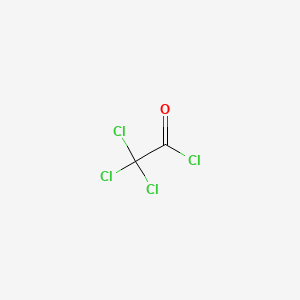
| IUPAC Name | 2,2,2-trichloroacetyl chloride |
| Molecular Formula | C2Cl4O |
| Molecular Weight | 181.8 g/mol |
| CAS | 76-02-8 |
| SMILES | C(=O)(C(Cl)(Cl)Cl)Cl |
| InChIKey | PVFOMCVHYWHZJE-UHFFFAOYSA-N |
| Catalog No | KC.2010159 |
| Pack sizes | 25GM · 100GM |
⚠️ For information only; not a substitute for the official SDS.