
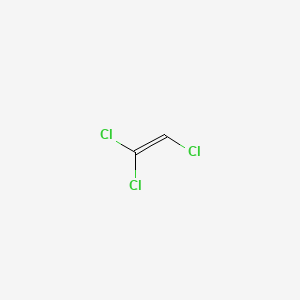
Trichloroethene is a member of the class of chloroethenes that is ethene substituted by chloro groups at positions 1, 1 and 2. It has a role as an inhalation anaesthetic and a mouse metabolite.
 Irritant
 Health hazard
⚠️ For information only; not a substitute for the official Safety Data Sheet (SDS).
Trichloroethene is a member of the class of chloroethenes that is ethene substituted by chloro groups at positions 1, 1 and 2. It has a role as an inhalation anaesthetic and a mouse metabolite.
| Physical Description | Trichloroethylene appears as a clear colorless volatile liquid having a chloroform-like odor. Denser than water and is slightly soluble in water. Noncombustible. Used as a solvent, fumigant, in the… |
| Color/Form | Colorless liquid (unless dyed blue) |
| Odor | Ethereal odor |
| Melting Point | -99 °F (NTP, 1992) |
| Boiling Point | 189 °F at 760 mmHg (NTP, 1992) |
| Flash Point | greater than 200 °F (NTP, 1992) |
| Density | 1.46 at 68 °F (USCG, 1999) - Denser than water; will sink |
| Solubility | less than 1 mg/mL at 70 °F (NTP, 1992) |
| Vapor Pressure | 60 mmHg at 68 °F ; 77 mmHg at 77 °F (NTP, 1992) |
| Refractive Index | Index of refraction: 1.4773 at 20 °C/D |
| Stability/Shelf Life | Stable under recommended storage conditions. |
| IUPAC Name | 1,1,2-trichloroethene |
| Molecular Formula | C2HCl3 |
| Molecular Weight | 131.38 g/mol |
| CAS | 79-01-6 |
| SMILES | C(=C(Cl)Cl)Cl |
| InChIKey | XSTXAVWGXDQKEL-UHFFFAOYSA-N |
| Catalog No | KC.2010161 |
| Pack sizes | 500ML · 2.5LTR |
⚠️ For information only; not a substitute for the official SDS.