
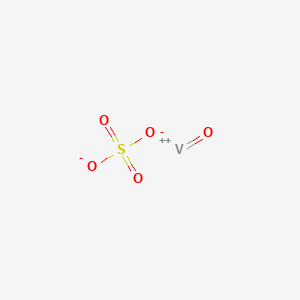
Vanadyl sulfate is a vanadium coordination entity and a metal sulfate.
 Corrosive
 Acute toxic
 Irritant
 Health hazard
 Environmental hazard
⚠️ For information only; not a substitute for the official Safety Data Sheet (SDS).
Vanadyl sulfate is a vanadium coordination entity and a metal sulfate.
| Physical Description | Vanadyl sulfate appears as a blue crystalline solid. Very soluble in water. Denser than water. Contact may irritate skin, eyes, and mucous membranes. May be toxic by ingestion, inhalation and skin … |
| Melting Point | MP: decomposes at 265 °C /Vanadyl sulfate dihydrate/ |
| Density | Density: 2.06 at 20 °C, in comparison to water at 4 °C /Vanadyl sulfate pentahydrate/ |
| Solubility | Solubility: In water, 467 g/L at 20 °C (pH 0.81-1.07) /Vanadyl sulfate pentahydrate/ |
| Stability/Shelf Life | Stable under recommended storage conditions. /Vanadium(IV) oxide sulfate hydrate/ |
| IUPAC Name | oxovanadium(2+) sulfate |
| Molecular Formula | O5SV |
| Molecular Weight | 163.01 g/mol |
| CAS | 27774-13-6 |
| SMILES | [O-]S(=O)(=O)[O-].O=[V+2] |
| InChIKey | UUUGYDOQQLOJQA-UHFFFAOYSA-L |
| Catalog No | KC.2210005 |
| Pack sizes | 100GM |
⚠️ For information only; not a substitute for the official SDS.