
Ethylene dichloride (1,2-Dichloroethane) can cause cancer according to an independent committee of scientific and health experts.
 Flammable
 Irritant
 Health hazard
⚠️ For information only; not a substitute for the official Safety Data Sheet (SDS).
Ethylene dichloride (1,2-Dichloroethane) can cause cancer according to an independent committee of scientific and health experts.
| Physical Description | Ethylene dichloride appears as a clear colorless liquid with a chloroform-like odor. Flash point 56 °F. Denser than water and insoluble in water. Vapors are heavier than air. Density 10.4 lb / gal. |
| Color/Form | Heavy liquid |
| Odor | Pleasant, chloroform-like |
| Melting Point | -31.5 °F (NTP, 1992) |
| Boiling Point | 182.3 °F at 760 mmHg (NTP, 1992) |
| Flash Point | 56 °F (NTP, 1992) |
| Density | 1.253 at 68 °F (USCG, 1999) - Denser than water; will sink |
| Solubility | 5 to 10 mg/mL at 66 °F (NTP, 1992) |
| Vapor Pressure | 60 mmHg at 68 °F ; 100 mmHg at 84.9 °F (NTP, 1992) |
| Refractive Index | Index of refraction: 1.4422 at 25 °C/D |
| Stability/Shelf Life | Stable under recommended storage conditions. |
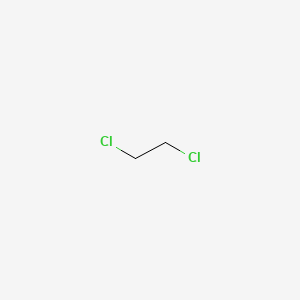
| IUPAC Name | 1,2-dichloroethane |
| Molecular Formula | C2H4Cl2 |
| Molecular Weight | 98.96 g/mol |
| CAS | 107-06-2 |
| SMILES | C(CCl)Cl |
| InChIKey | WSLDOOZREJYCGB-UHFFFAOYSA-N |
| Catalog No | KC.-1510027 |
| Pack sizes | 500ML · 2.5LTR |
⚠️ For information only; not a substitute for the official SDS.