
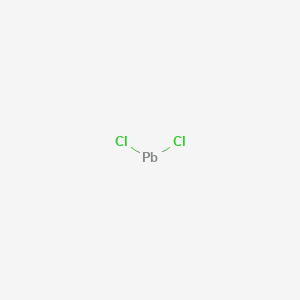
Lead(II) chloride is an inorganic chloride consisting of two chlorine atoms covalently bound to a central lead atom. It is an inorganic chloride and a lead coordination entity.
 Irritant
 Health hazard
 Environmental hazard
⚠️ For information only; not a substitute for the official Safety Data Sheet (SDS).
Lead(II) chloride is an inorganic chloride consisting of two chlorine atoms covalently bound to a central lead atom. It is an inorganic chloride and a lead coordination entity.
| Physical Description | Lead chloride appears as a white solid. |
| Color/Form | White crystalline powder |
| Melting Point | 933.8 °F (USCG, 1999) |
| Boiling Point | 1742 °F at 760 mmHg (USCG, 1999) |
| Density | 5.85 at 68 °F (USCG, 1999) - Denser than water; will sink |
| Solubility | Slightly sol in dilute HCl and ammonia; insoluble in alcohol |
| Vapor Pressure | 1 [mm Hg] @547 °C |
| Refractive Index | Index of refraction: 2.199, 2.217, 2.260 |
| IUPAC Name | dichlorolead |
| Molecular Formula | Cl2Pb |
| Molecular Weight | 278 g/mol |
| CAS | 7758-95-4 |
| SMILES | Cl[Pb]Cl |
| InChIKey | HWSZZLVAJGOAAY-UHFFFAOYSA-L |
| Catalog No | KC.1210074 |
| Pack sizes | 500GM |
⚠️ For information only; not a substitute for the official SDS.