
Lead fluoride is an odorless white solid. Sinks in water. (USCG, 1999)
 Irritant
 Health hazard
 Environmental hazard
⚠️ For information only; not a substitute for the official Safety Data Sheet (SDS).
Lead fluoride is an odorless white solid. Sinks in water. (USCG, 1999)
| Physical Description | Lead fluoride is an odorless white solid. Sinks in water. (USCG, 1999) |
| Color/Form | White to colorless crystals |
| Odor | Odorless |
| Melting Point | 830 °C |
| Boiling Point | 1293 °C |
| Density | 8.24 at 68 °F (USCG, 1999) - Denser than water; will sink |
| Solubility | Dimorphous: orthorhombic, converted to cubic above 316 °C; Solubility increases in the presence of nitric acid or nitrates |
| Vapor Pressure | 10 [mm Hg] @904 °C |
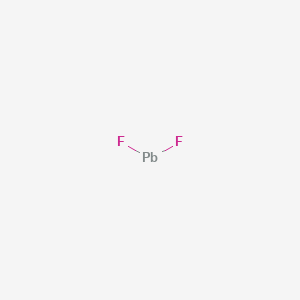
| IUPAC Name | difluorolead |
| Molecular Formula | F2Pb |
| Molecular Weight | 245 g/mol |
| CAS | 7783-46-2 |
| SMILES | F[Pb]F |
| InChIKey | FPHIOHCCQGUGKU-UHFFFAOYSA-L |
| Catalog No | KC.1210077 |
| Pack sizes | 500GM |
⚠️ For information only; not a substitute for the official SDS.