
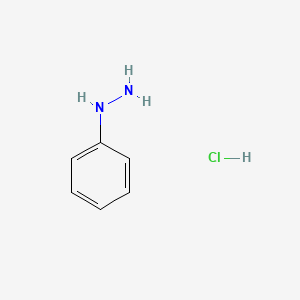
Phenylhydrazine hydrochloride is a white to tan solid with a weak aromatic odor. (EPA, 1998)
 Acute toxic
 Health hazard
 Environmental hazard
⚠️ For information only; not a substitute for the official Safety Data Sheet (SDS).
Phenylhydrazine hydrochloride is a white to tan solid with a weak aromatic odor. (EPA, 1998)
| Physical Description | Phenylhydrazine hydrochloride is a white to tan solid with a weak aromatic odor. (EPA, 1998) |
| Melting Point | 469 to 475 °F (EPA, 1998) |
| Boiling Point | Not pertinent; it decomposes (EPA, 1998) |
| Density | Greater than 1 at 68 °F (EPA, 1998) |
| IUPAC Name | phenylhydrazine;hydrochloride |
| Molecular Formula | C6H9ClN2 |
| Molecular Weight | 144.60 g/mol |
| CAS | 59-88-1 |
| SMILES | C1=CC=C(C=C1)NN.Cl |
| InChIKey | JOVOSQBPPZZESK-UHFFFAOYSA-N |
| Catalog No | KC.1610128 |
| Pack sizes | 100GM · 250GM · 500GM |
⚠️ For information only; not a substitute for the official SDS.