
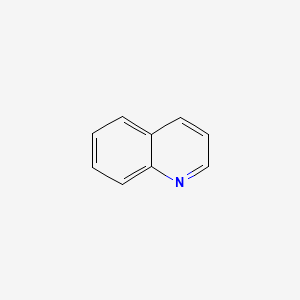
quinoline has been reported in Gymnodinium nagasakiense, Averrhoa carambola, and other organisms with data available.
 Irritant
 Health hazard
 Environmental hazard
⚠️ For information only; not a substitute for the official Safety Data Sheet (SDS).
quinoline has been reported in Gymnodinium nagasakiense, Averrhoa carambola, and other organisms with data available.
| Physical Description | Quinoline appears as a colorless liquid with a peculiar odor. Slightly denser than water. Contact may irritate to skin, eyes, and mucous membranes. May be toxic by ingestion. Used to make other che… |
| Color/Form | COLORLESS TO BROWN /SRP: TECHNICAL GRADE/ |
| Odor | Penetrating odor, not as offensive as pyridine |
| Melting Point | 5 °F (NTP, 1992) |
| Boiling Point | 460 °F at 760 mmHg (NTP, 1992) |
| Flash Point | 138 °F (NFPA, 2010) |
| Density | 1.095 at 68 °F (USCG, 1999) - Denser than water; will sink |
| Solubility | less than 0.1 mg/mL at 72.5 °F (NTP, 1992) |
| Vapor Pressure | 1 mmHg at 139.5 °F ; 5 mmHg at 193.3 °F (NTP, 1992) |
| Refractive Index | Index of refraction: 1.62683 @ 20 °C/D |
| Stability/Shelf Life | DARKENS ON STORAGE IN ORDINARY, STOPPERED BOTTLE |
| IUPAC Name | quinoline |
| Molecular Formula | C9H7N |
| Molecular Weight | 129.16 g/mol |
| CAS | 91-22-5 |
| SMILES | C1=CC=C2C(=C1)C=CC=N2 |
| InChIKey | SMWDFEZZVXVKRB-UHFFFAOYSA-N |
| Catalog No | KC.1710010 |
| Pack sizes | 500ML · 2.5LTR |
⚠️ For information only; not a substitute for the official SDS.