
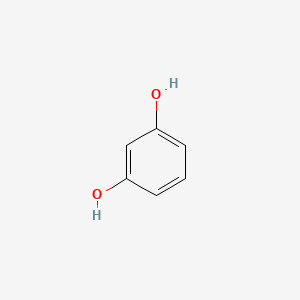
Resorcinol is a benzenediol that is benzene dihydroxylated at positions 1 and 3. It has a role as a sensitiser and an erythropoietin inhibitor. It is a phenolic donor, a benzenediol and a member of resorcinols.
 Irritant
 Health hazard
 Environmental hazard
⚠️ For information only; not a substitute for the official Safety Data Sheet (SDS).
Resorcinol is a benzenediol that is benzene dihydroxylated at positions 1 and 3. It has a role as a sensitiser and an erythropoietin inhibitor. It is a phenolic donor, a benzenediol and a member of resorcinols.
| Physical Description | Resorcinol is a very white crystalline solid that becomes pink on exposure to light if not completely pure. Burns although ignition is difficult. Density approximately 1.28 g / cm3. Irritating to s… |
| Color/Form | White needle-like crystals |
| Odor | Faint, characteristic odor |
| Melting Point | 228 to 232 °F (NTP, 1992) |
| Boiling Point | 531 to 536 °F at 760 mmHg (NTP, 1992) |
| Flash Point | 261 °F (NTP, 1992) |
| Density | 1.2 at 68 °F (USCG, 1999) - Denser than water; will sink |
| Solubility | greater than or equal to 100 mg/mL at 65.3 °F (NTP, 1992) |
| Vapor Pressure | 1 mmHg at 227.1 °F ; 0.0002 mmHg at 77 °F (NTP, 1992) |
| Refractive Index | Index of refraction = 1.578 at 25 °C/D |
| Stability/Shelf Life | Hygroscopic |
| IUPAC Name | benzene-1,3-diol |
| Molecular Formula | C6H6O2 |
| Molecular Weight | 110.11 g/mol |
| CAS | 108-46-3 |
| SMILES | C1=CC(=CC(=C1)O)O |
| InChIKey | GHMLBKRAJCXXBS-UHFFFAOYSA-N |
| Catalog No | KC.1810008 |
| Pack sizes | 100GM · 250GM · 500GM |
⚠️ For information only; not a substitute for the official SDS.