TerraSystem bonds track ballast by machine with the EBA-approved epoxy resin GREBOPOX®: against ballast flight, for switches, transition zones, embankments and construction sites next to live track. Klar Chem is the authorized TerraSystem distributor in 24 countries across Türkiye, the Middle East, North Africa and Eurasia.
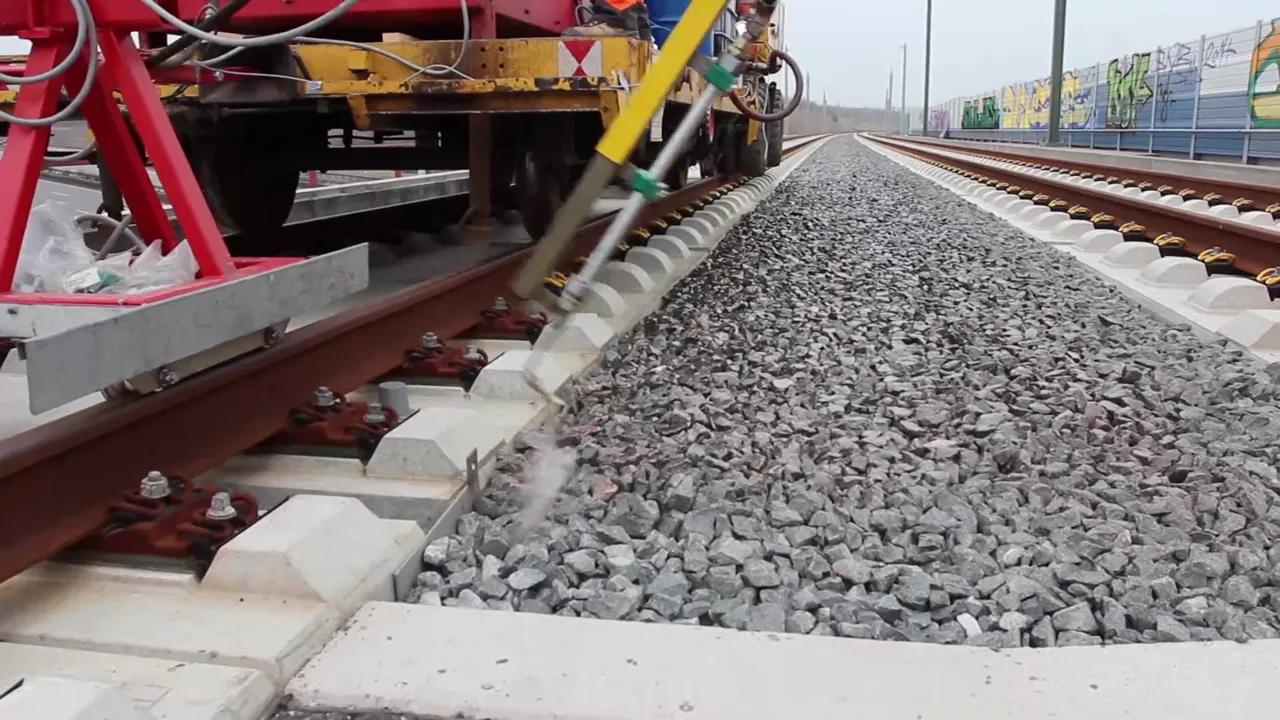
Ballast bonding is the application of a liquid two-component binder to the ballast bed. The binder joins the stones only at their contact points, so the voids stay open: the ballast is held in place, while rainwater still drains freely through the bed.
Depending on the task, only the surface, the ballast shoulder or the full depth of the bed is bonded. Ballast bonding, ballast stabilization, ballast consolidation and glued ballast all describe the same principle.
The ballast bed stays fully permeable
Bonded ballast can still be tamped, recycled and re-bonded
Machine application gives an even, reproducible penetration depth
One method for eight typical problems on ballasted track.
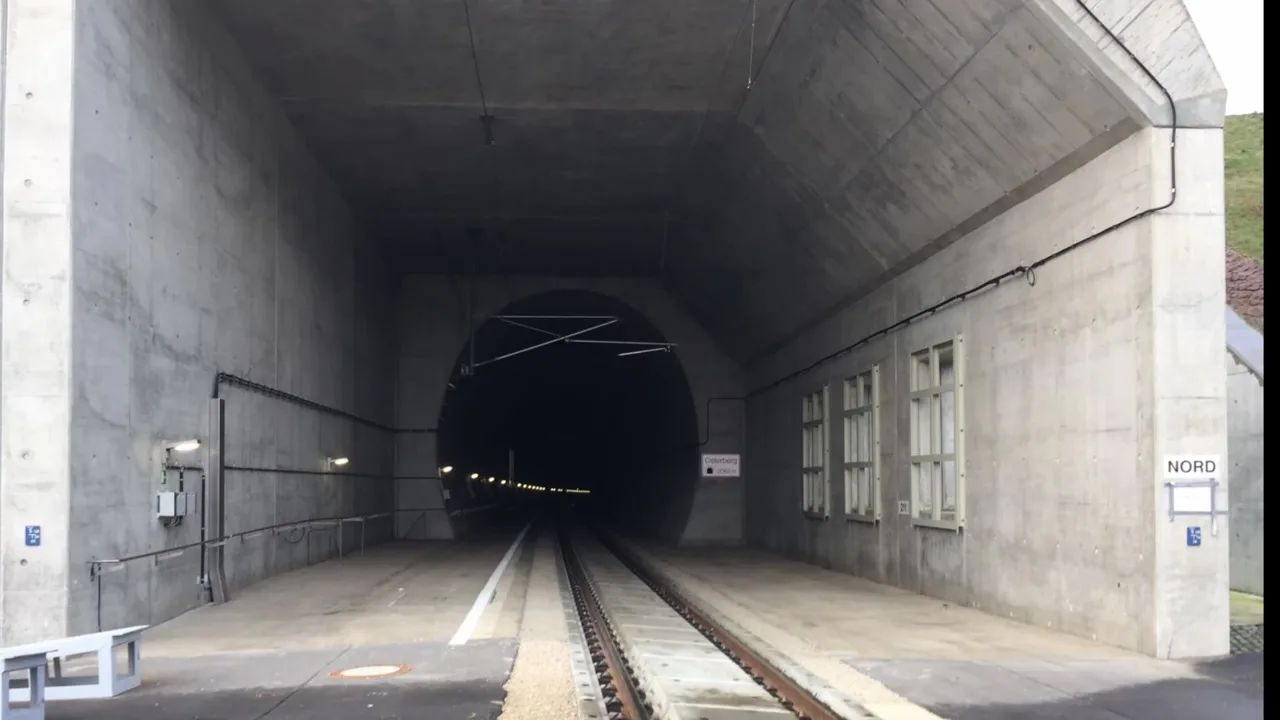
At high speed, especially in tunnels and on bridges, train suction and falling ice can lift ballast stones and damage rails, rolling stock and equipment. Surface bonding fixes the top layer permanently. Its effect against ballast flight has been confirmed in studies by DB, SNCF and JR; the method is patented.
Higher speeds and axle loads put switches, insulated rail joints and tight curves under particular strain. Deep bonding raises lateral track resistance 8 to 10 times compared with conventional ballast and considerably extends tamping intervals.
Where ballasted track meets slab track or a bridge, different stiffnesses and settlements drive up maintenance. Bonding that tapers off in steps evens out the difference; a typical pattern bonds about one third fully and two thirds partially. Transitions built in France were fully intact after eight years in service.
When the formation of an adjacent track is renewed, it lies about 1–1.5 m below rail level. Passing trains and compaction equipment can set the ballast in front of the sleeper ends rolling. Temporary bonding keeps the live track laterally stable.
Bonded embankments and shoulders are protected against erosion and slipping. Where there is no room for a full ballast shoulder, bonding still achieves the required lateral resistance.
Loose ballast at stations is hard to clean: vacuum cleaning picks up stones, high-pressure cleaning displaces them. Surface bonding makes the ballast cleanable and creates walkable escape and maintenance routes.
A patented special process makes theft of copper cables in the track area much harder.
Bonded surfaces keep light out of the ballast bed, so plants hardly take root: an alternative to chemical weed control.
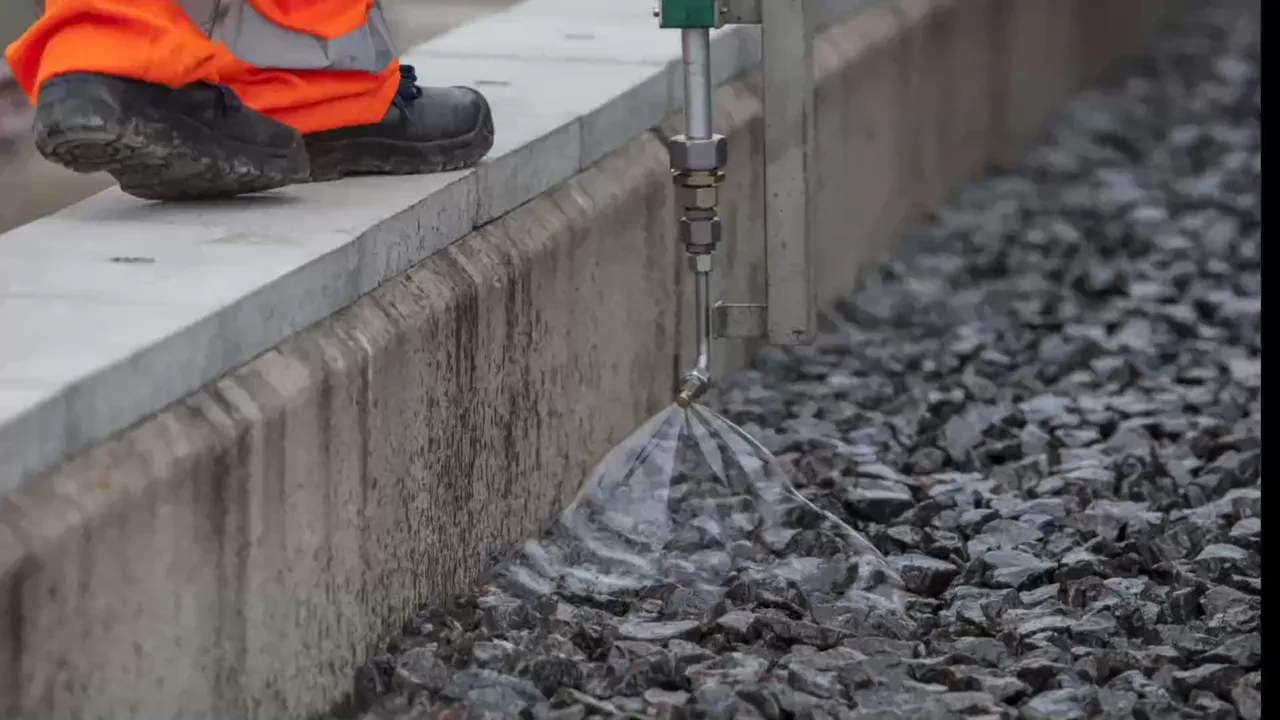
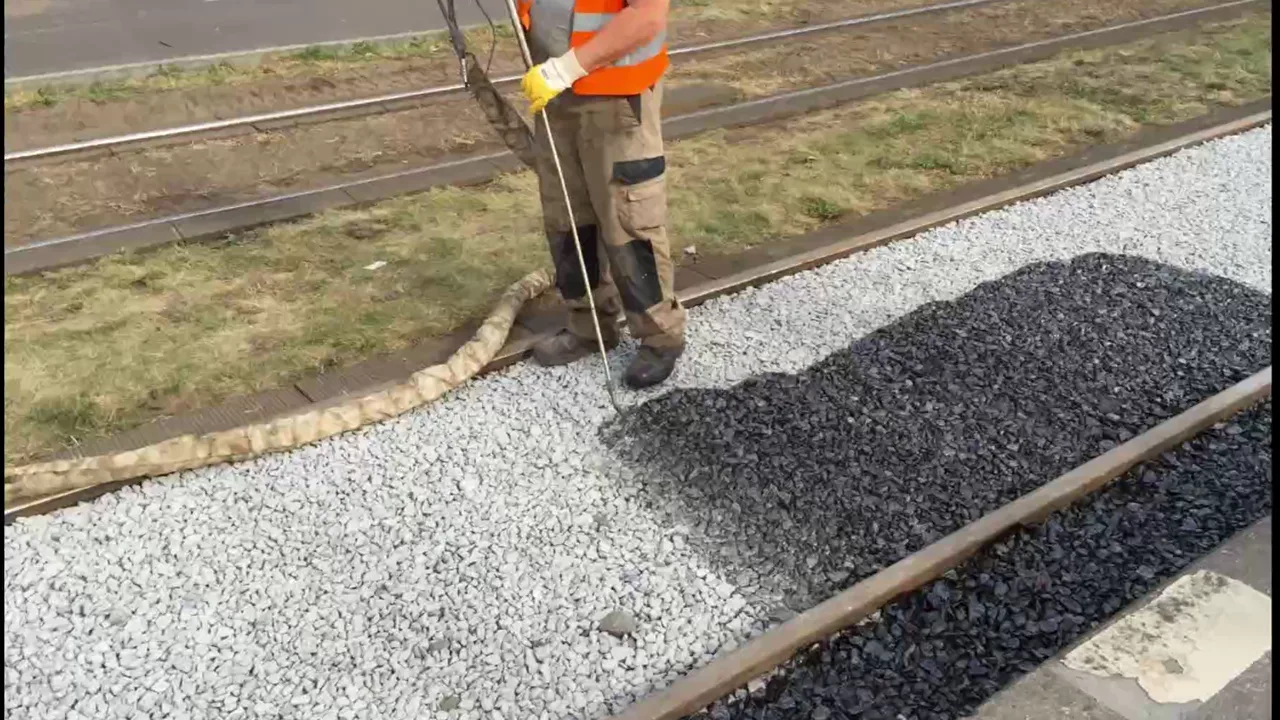
Better track stability and longer tamping and maintenance intervals
The ballast bed stays fully permeable, even under heavy rain or high-pressure cleaning
High machine output keeps possessions short
Can be applied from +2 °C, on damp ballast and in light rain
Sound-absorbing effect, for example on urban transit lines
Bonded ballast can be tamped, recycled and reused: no hazardous-waste disposal
Fire class A2fl-s1 (EN 13501), approved for tunnel sections on DB lines
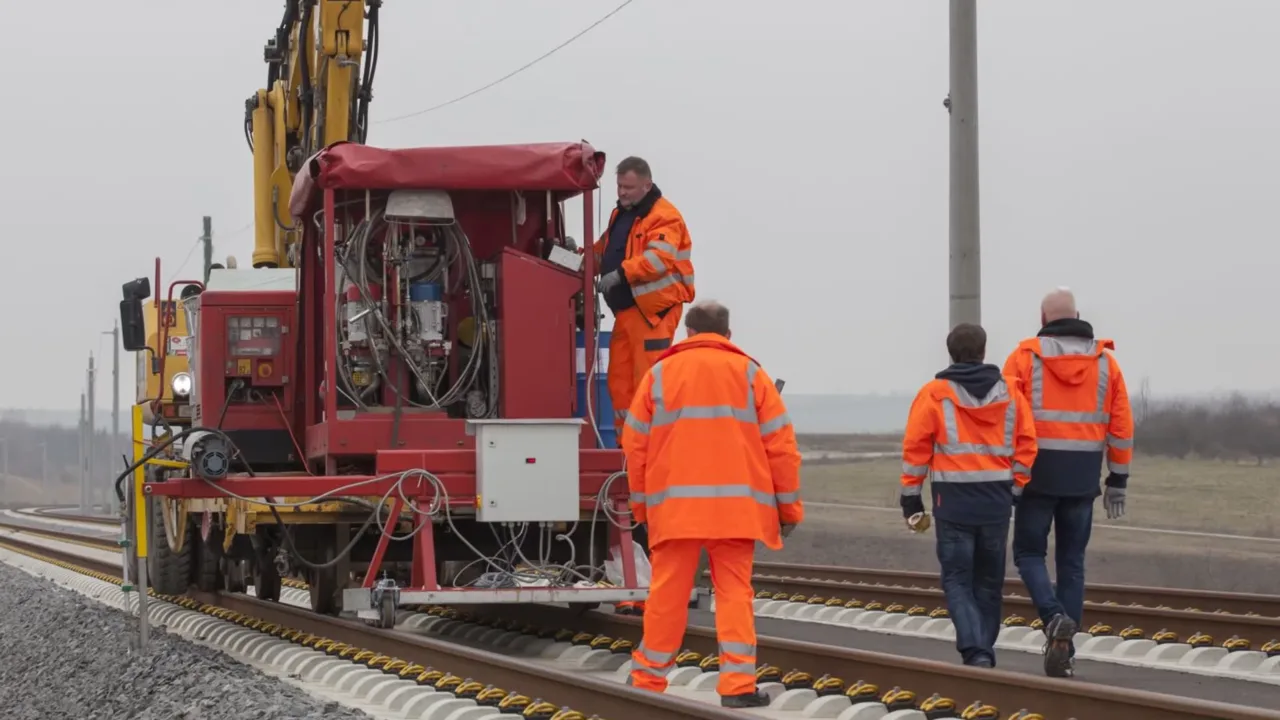
The bonding is carried out with mobile two-component hot-mix units. Resin and hardener (amine) are brought to a constant temperature in a closed system, mixed homogeneously and sprayed onto the ballast through nozzles chosen for each application. The binder is GREBOPOX®, an epoxy resin by Gremmler Bauchemie GmbH that tolerates residual moisture and was developed for outdoor use; TerraSystem has used it as its only ballast bonding resin since 2012.
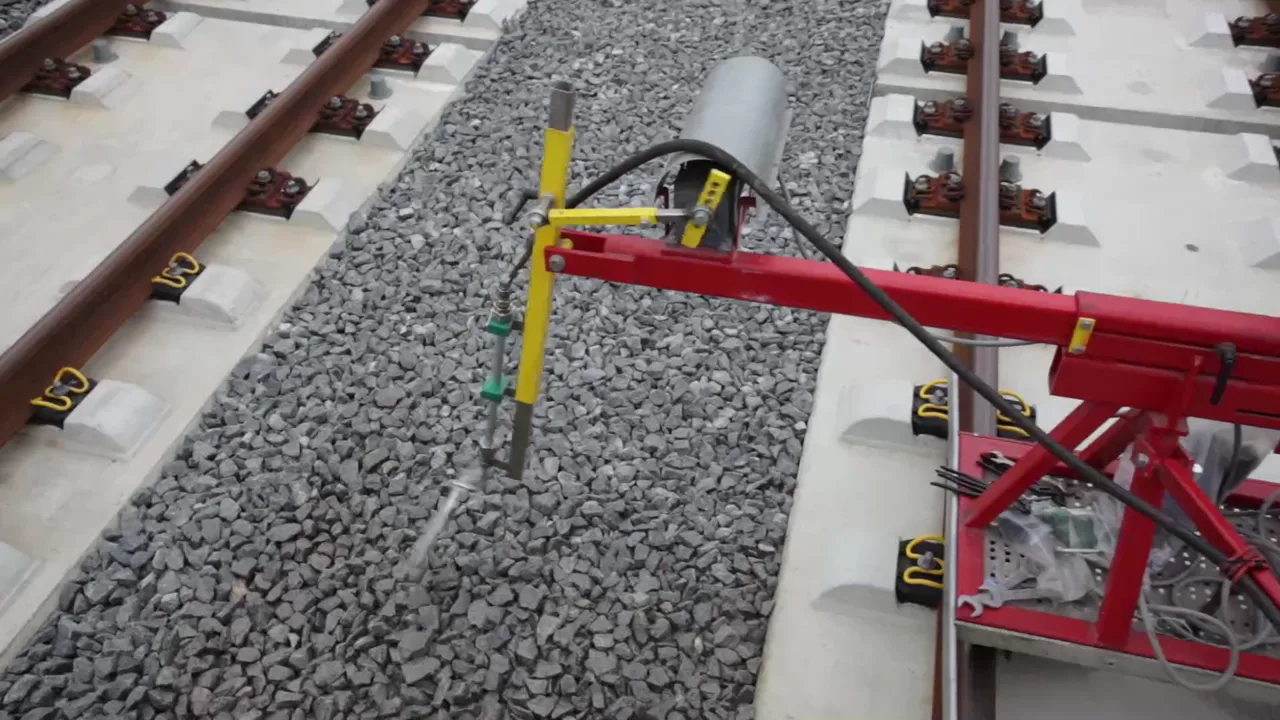
| Binder | GREBOPOX® two-component epoxy resin + amine hardener (Gremmler Bauchemie GmbH) |
|---|---|
| Penetration depth | up to 30–60 cm, depending on ballast grading |
| Working time | approx. 30 minutes |
| Curing time | 3–6 hours |
| Application conditions | from +2 °C, also on damp ballast and in light rain |
| Machine output | approx. 5, 10, 25 and 30 kg/min (four unit sizes) |
| Fire classification | A2fl-s1 to EN 13501 (Exova Warringtonfire, report 2005-1858-K1) |
| Bonding types | surface bonding, shoulder bonding, deep bonding, pattern bonding for transitions |
Values from Terra System GmbH technical documentation. The right method and quantities are determined for each project.
Approval by the German Federal Railway Authority (EBA)
Standard construction method of Deutsche Bahn for several applications
Long-term test over 125 million load tonnes (about seven years on an average track) with no damage to the bond
Load tests at the Testing Institute for Transport Infrastructure, TU Munich: displacement tests at 90 kN, elastic deflection approx. 0.1 mm
Freeze-thaw and de-icing salt resistance of epoxy-bonded track ballast tested (ISFT Mendig)
In service on railways in Germany, Austria, Switzerland, France, the UK, Japan, Australia and Canada
Terra System GmbH quality management to ISO 9001:2015

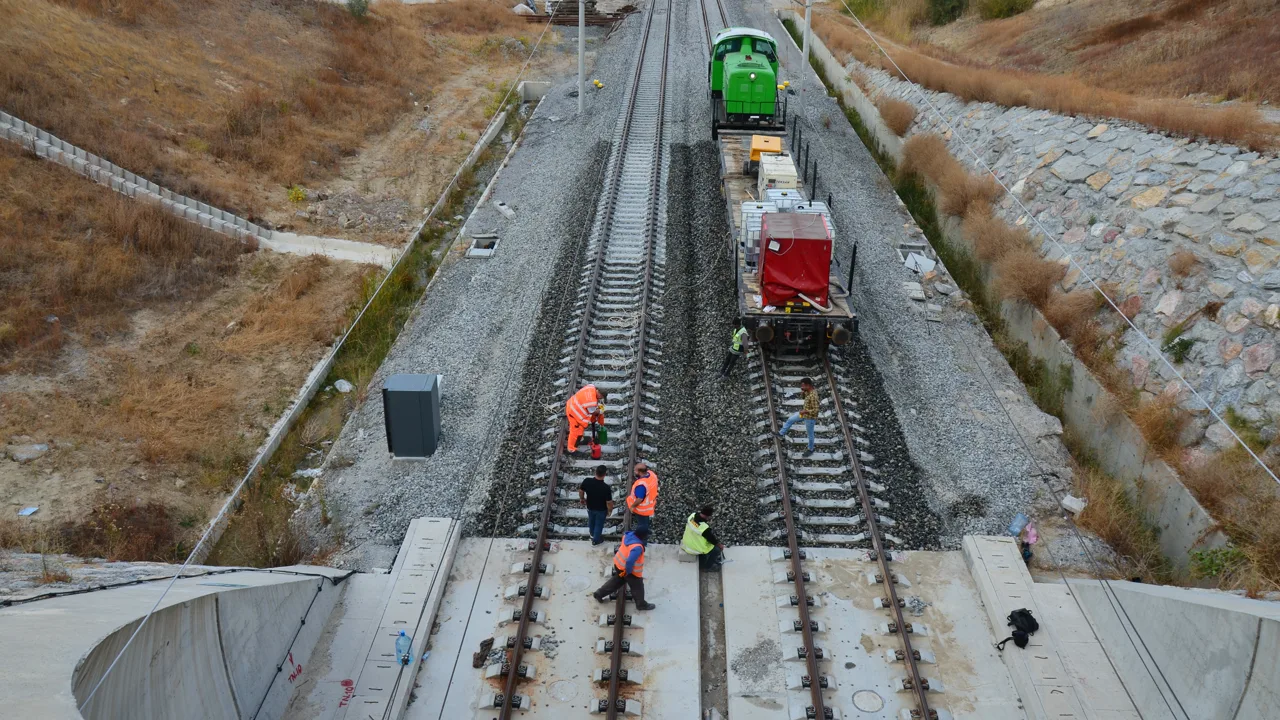
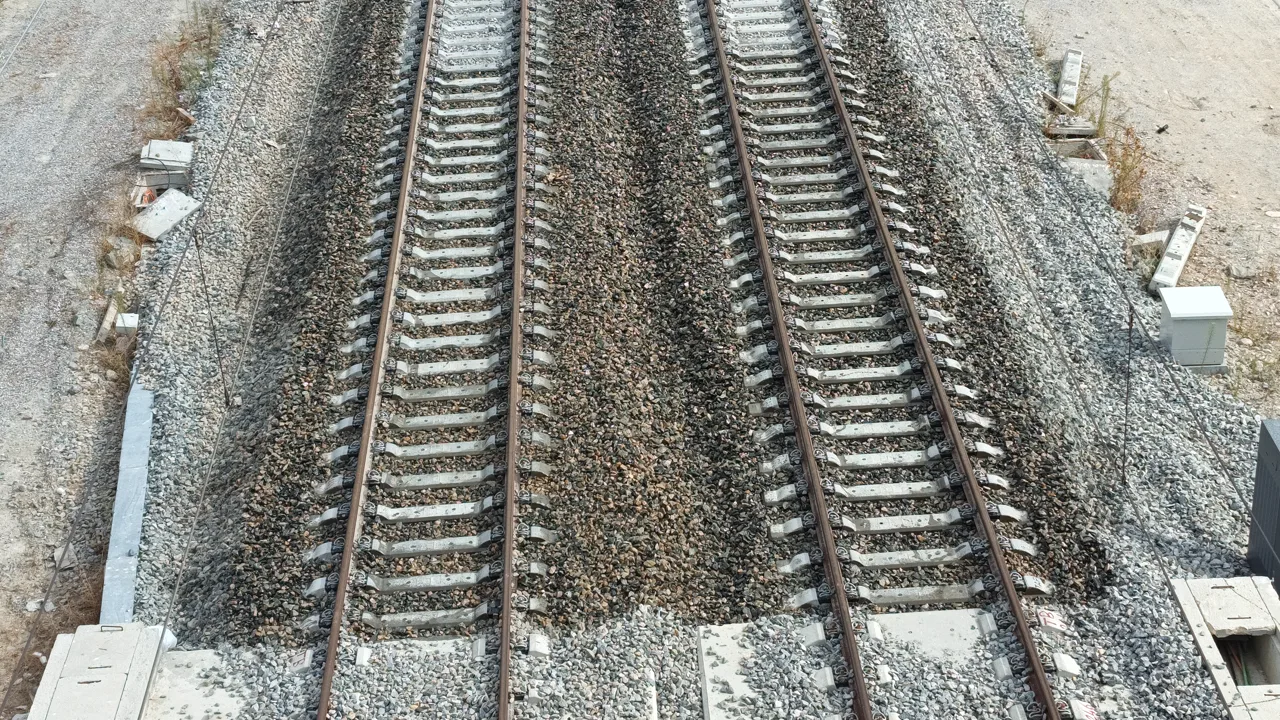
TerraSystem ballast bonding is included in TCDD (Turkish State Railways) technical specifications and has been used on TCDD high-speed rail projects since 2019.
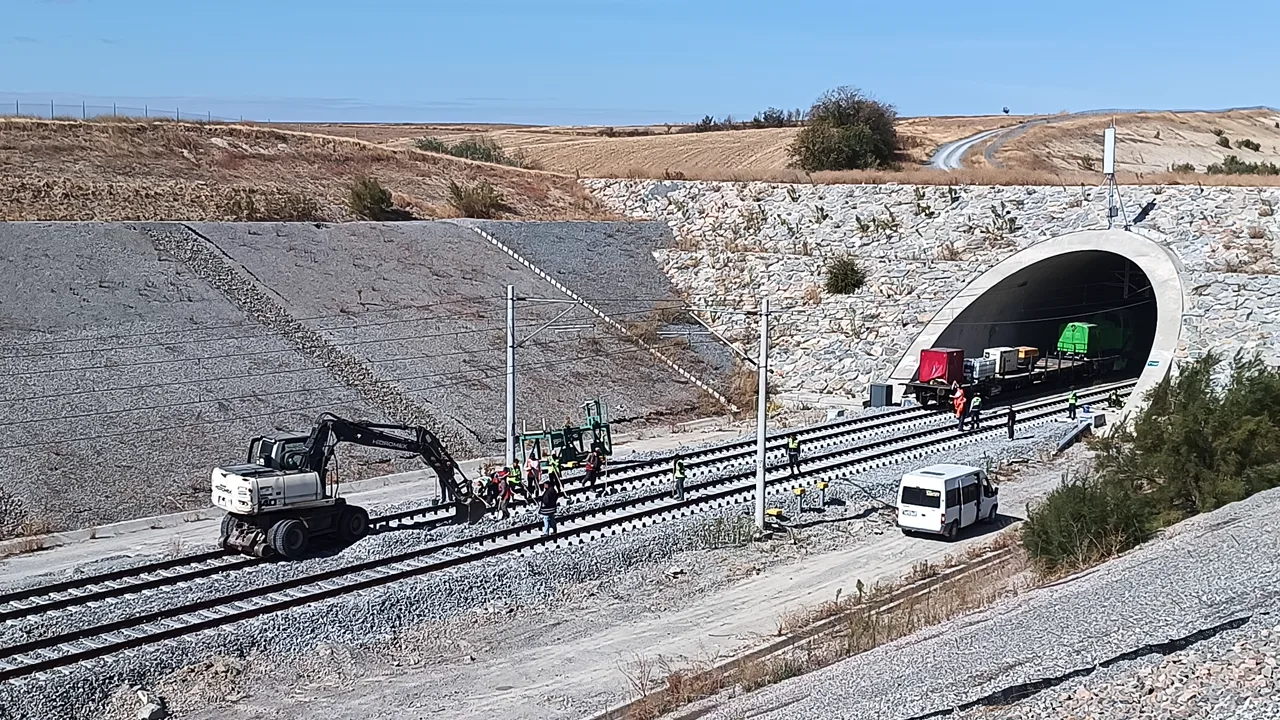
| Project | Contractor | Year |
|---|---|---|
| Sapanca–Geyve high-speed line | AGA Enerji – Bayburt Group | 2019–2020 |
| Kayaş–Yerköy high-speed line (Ankara) | Doğuş Group | 2020–2021 |
| Ankara–Elmadağ high-speed line | Doğuş Group | 2024 |
| Yerköy–Sivas high-speed line | Yapı Merkezi | 2022–2023 |
| Babaeski–Havsa (Edirne) high-speed line | Kolin İnşaat | 2025 |
| Bursa high-speed line | Kalyon Group | 2027 |
Italy, RFI – Milan–Turin high-speed line: 54,000 m² against ballast flight (2016)
Germany, DB – Erfurt–Ilmenau high-speed line: 11,000 m² against ballast flight and 360 m of transition bonding (2015–2016)
Greece, OSE – Lamia: 8 transitions of 45 m each (2017)
Austria, ÖBB – Vienna: 600 m² embankment stabilization (2017)
Germany, Berlin S-Bahn – Zoo station: transitions on two tracks (2017)
Germany – Kaiser Wilhelm Tunnel (Cochem): transition between ballasted and slab track (2017)
International references: Terra System GmbH reference list (2018).
Klar Chem is the authorized distributor of Terra System GmbH in 24 countries, including the regions below. We are your contact for technical documentation, tender support, quotation and project coordination with the TerraSystem engineering team in Germany.
Head office in Istanbul
Saudi Arabia, UAE, Qatar, Kuwait, Bahrain, Oman, Iraq, Jordan, Lebanon
Egypt, Morocco, Algeria, Tunisia, Libya
Azerbaijan, Georgia, Kazakhstan, Uzbekistan, Kyrgyzstan, Turkmenistan
Line or station, the problem to solve, length or area, and the available possession window.
Drawings or a site visit; choice of method: surface, shoulder, deep or pattern bonding.
Quantities, schedule and logistics matched to possessions and operations.
For quality and warranty, TerraSystem's own technical crew carries out the on-site bonding with two-component units and documents it for the client.
None in principle: ballast bonding, ballast stabilization, ballast consolidation and glued ballast all mean joining the ballast stones at their contact points with a binder so that the bed stays in place but remains permeable.
Working time is about 30 minutes and curing takes 3 to 6 hours, so the work fits into normal possessions.
GREBOPOX® can be applied from +2 °C. It tolerates residual moisture, so it can be applied to damp ballast and in light rain.
Yes. The stones are joined only at their contact points and the voids stay open, so water drains freely. Heavy rain or high-pressure cleaning do not wash the ballast out.
Yes. Bonded ballast can be tamped, recycled, reused or bonded again, and no hazardous-waste disposal is required.
Yes. GREBOPOX® has fire class A2fl-s1 under EN 13501 and is approved for tunnel sections on DB lines.
Klar Chem is the authorized TerraSystem distributor in 24 countries in Türkiye, the Gulf and Middle East, North Africa, the Caucasus and Central Asia. Send us the project location and we will confirm the details.
For quality control and an application warranty, TerraSystem's own technical crew carries out the on-site work on every TerraSystem project. Klar Chem is your contact for quotes, documents and project coordination.
The line or station, the application (ballast flight, switches, transition, embankment, construction site, platform), the length or area, the ballast grading if known, and the possession window. Drawings help us give a faster technical assessment.
Tell us about the line, the application and your time window. We will come back with a technical assessment and a quote.
